Current Research
Seasonal abundances and movement patterns of bottlenose dolphins
Very little is known about the population size and identities of bottlenose dolphins that inhabit the waters surrounding the Outer Banks. We believe that the numbers of dolphins in this area change seasonally with the most dolphins occurring in the sounds during the summer. Understanding how population size changes throughout the year can influence important management decisions for conserving bottlenose dolphins. Greater insight into their seasonal movements can illustrate site fidelity patterns and aid in determining intermixing between populations. Our goals are to study changes in population size and demographics over time and to determine the identities and residency patterns of dolphins in this area. Our research supports the Mid-Atlantic Bottlenose Dolphin Catalog (MABDC), a collaborative effort between researchers on the U.S. Atlantic Coast to gain a better understanding of bottlenose dolphin stock structure and movement patterns. By comparing dolphins observed in the Outer Banks to those seen in other areas of the east coast, we can learn more about their longer range seasonal movement patterns.

Bottlenose dolphin social associations
Bottlenose dolphins have been known to exhibit sex-specific social associations. We believe that bottlenose dolphins in the Outer Banks exhibit similar associations to those documented in other areas. In particular, we are interested in examining the presence of male pair bonds within a seasonally resident population. We are also interested in gaining further insight into female-female associations.

Skin disease
Various types of skin diseases have been visually documented in bottlenose dolphin communities. Our goal is to characterize types of skin disease observed on dolphins in this area through the use of photo-identification. We are also interested in examining seasonal trends to the occurrence of skin lesions and the influence of any potential environmental factors that may affect the prevalence of dolphin skin disease.
Taylor JS, Hart LB, Adams J. 2020. Skin lesion prevalence of estuarine common bottlenose dolphins (Tursiops truncatus) in North Carolina, with comparisons to other east coast study sites. Mar Mam Sci. 1–15. https://doi.org/10.1111/mms.12731

Habitat Utilization
Roanoke Sound provides a primarily seasonal habitat for bottlenose dolphins from late spring to early fall (Waring et al., 2014). Little information is known about how dolphins utilize this seasonal habitat for specific behaviors and its ecological importance to this species. Photo-identification transect data and opportunistic data are being analyzed by Shauna McBride-Kebert, who is a Research Assistant at the Chicago Zoological Society’s Sarasota Dolphin Research Program.
The objectives of this dissertation study are to identify areas in Roanoke Sound that are frequently utilized by dolphins and what behaviors occur most often in these areas. Additionally, habitat utilization results are analyzed separately for transect survey data and opportunistic survey data and these results are compared to examine reliability across survey methods. This study provides information about how dolphins utilize Roanoke Sound for specific behaviors.
McBride-Kebert, S, J.S.Taylor, K.A. Wilkinson, H., Lyn, F.R. Moore, D.F. Sacco, B. Kar, and S.A. Kuczaj II. 2019. Common bottlenose dolphin (Tursiops truncatus) seasonal habitat use and interactions with habitat characteristics in Roanoke Sound, North Carolina. International Journal of Comparative Psychology 32: 1-21. Click here to view PDF
McBride-Kebert, S, J.S. Taylor, H. Lyn, F.R. Moore, D.F. Sacco, B. Kar, and S.A. Kuczaj II. 2019. Controlling for survey effort is worth the effort: Comparing bottlenose dolphin (Tursiops truncatus) habitat use between standardized photo-identification surveys and opportunistic surveys. Aquatic Mammals 45(1): 21-29.
Literature Cited:
Waring, G. T., Josephson, E., Maze-Foley, K., and P. E. Rosel, eds. 2014. U.S. Atlantic and Gulf of Mexico Marine Mammal Stock Assessments – 2013. NOAA Tech Memo NMFS-NE-228, Woods Hole, MA. 475 p.
Research Methods
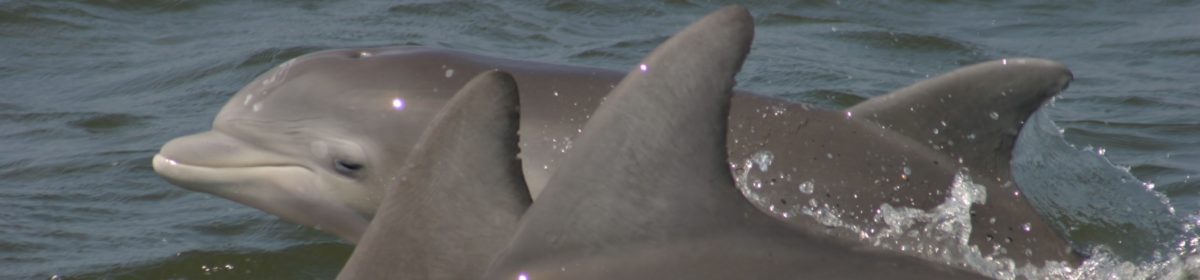
How do we conduct this research on bottlenose dolphins? We use a technique known as photo-identification. Photo-identification is a mark-recapture in which distinguishing markings are used to identify individuals. Bottlenose dolphins acquire distinctive markings on their dorsal fins as they go throughout their lives. We photograph the dorsal fin of each dolphin that we see. Each image is incorporated into a photo-identification catalog along with date, time, and location of where that dolphin has been seen. Over time, we can keep track of how many times we have seen each dolphin, where they were seen, and who they spend time with.

Opportunistic Data and Environmental Outreach:
The Outer Banks Center for Dolphin Research collaborates with the Nags Head Dolphin Watch to collect opportunistic photo-identification data and conduct environmental outreach programs to educate the public about dolphin conservation in the Outer Banks. Opportunistic photo-identification and outreach programs are conducted daily (Monday – Saturday) during the months of May through September. Such opportunistic data is used to gain a further understanding of the movement patterns and presence of individuals during the summer months in the Outer Banks.
Intern Research Projects:
Every year, the OBXCDR accepts 1-2 interns to assist with field data collection and photo-id processing. Each intern is also responsible for completing an independent project in support of the MABDC. A final project report is the final product of the independent project. See past intern projects below:
Emma Bancroft, 2020
Seasonal Exchange of Bottlenose Dolphins Between Roanoke Sound and Beaufort, North Carolina
Jacquelyn Salguero, 2020
Molly Albright, 2020
Assessing Skin Lesion Progression and Resolution in Bottlenose Dolphins
(Tursiops truncatus)
Niki Cleary, 2020
Makenzie Grider, 2019
Examining the northern spatial extent of estuarine bottlenose dolphins sighted in Roanoke Sound
Julia Jacobs, 2018
Jaclyn Doody, 2017
Sarah Elbon, 2017
Seasonal movements of bottlenose dolphins in the Outer Banks
Alaina Young, 2017
Emily Inkrote, 2017
Elizabeth Mason, 2016
Seasonal Exchange of Bottlenose Dolphins Resident to the Outer Banks of North Carolina
Ana Yanes, 2016
Seasonal Exchange of Bottlenose Dolphins Transient to the Outer Banks of North Carolina
Maggie Fuentes, 2015
Jessica McKeowan, 2014
Sighting Patterns of Bottlenose Dolphins Observed in the Outer Banks, NC
Conference Presentations:
Taylor, J.W., J. Olson, N. Bowles, and K. Rittmaster. 2011. Association patterns of seasonally resident bottlenose dolphins (Tursiops truncatus) at adjacent North Carolina study sites. Poster presentation at the Southeast and Mid-Atlantic Marine Mammal Symposium, 1-3 April 2011, Coastal Carolina University, Conway, SC.
Taylor, J., L. Hart, H. Krumsick, and J. Adams. 2014. Preliminary examination of skin lesions on bottlenose dolphins (Tursiops truncatus) in the Outer Banks, NC. Poster presentation at the Southeast and Mid-Atlantic Marine Mammal Symposium, 28-30 March 2014, University of North Carolina Wilmington, Wilmington, NC.
McBride, S. and J. Taylor. 2015. Comparison of bottlenose dolphin, Tursiops truncatus, hotspots across transect and opportunistic survey methods. Poster presentation at the Southeast and Mid-Atlantic Marine Mammal Symposium, 27-29 March 2015, Virginia Aquarium, Virginia Beach, VA.
Johnson, C.E. and J. Taylor. 2016. Water temperature thresholds of bottlenose dolphins in Roanoke Sound, NC. Poster presentation at the Southeast and Mid-Atlantic Marine Mammal Symposium, 1-3 April 2016. Savannah State University, Savannah, GA.
Shervanick, K. and J. Taylor. 2016. Are the northern North Carolina Estuarine System Stock bottlenose dolphins exhibiting seasonal variation of their home range? Poster presentation at the Southeast and Mid-Atlantic Marine Mammal Symposium, 1-3 April 2016, Savannah State University, Savannah, GA.
Taylor, J., H. Fearnbach, and J. Adams. 2016. Use of clustered mark-recapture methods to monitor bottlenose dolphins (Tursiops truncatus) in the Outer Banks, NC. Poster presentation at the Southeast and Mid-Atlantic Marine Mammal Symposium, 1-3 April 2016, Savannah State University, Savannah, GA.
Taylor, J. H. Fearnbach, and J. Adams. 2017. Use of clustered mark-recapture methods to monitor bottlenose dolphins (Tursiops truncatus) in the Outer Banks, NC. Poster presentation at the The Society for Marine Mammalogy’s 22nd Biennial Conference on the Biology of Marine Mammals, 22-27 October 2017, Halifax, Canada.
Taylor, J.S., L. Hart, and J. Adams. 2019. Skin lesions prevalence of estuarine bottlenose dolphins, Tursiops truncatus, in the Outer Banks of North Carolina with comparisons to other east coast study sites. Poster presentation at the World Marine Mammal Conference, 8-12 December 2019, Barcelona, Spain.